DSTI School of Engineering

Your AI & tech future in France.

A live discussion for prospective students and applicants: why France, why DSTI, how much it costs, and how the pathway connects studies, internship, work and life in Europe.

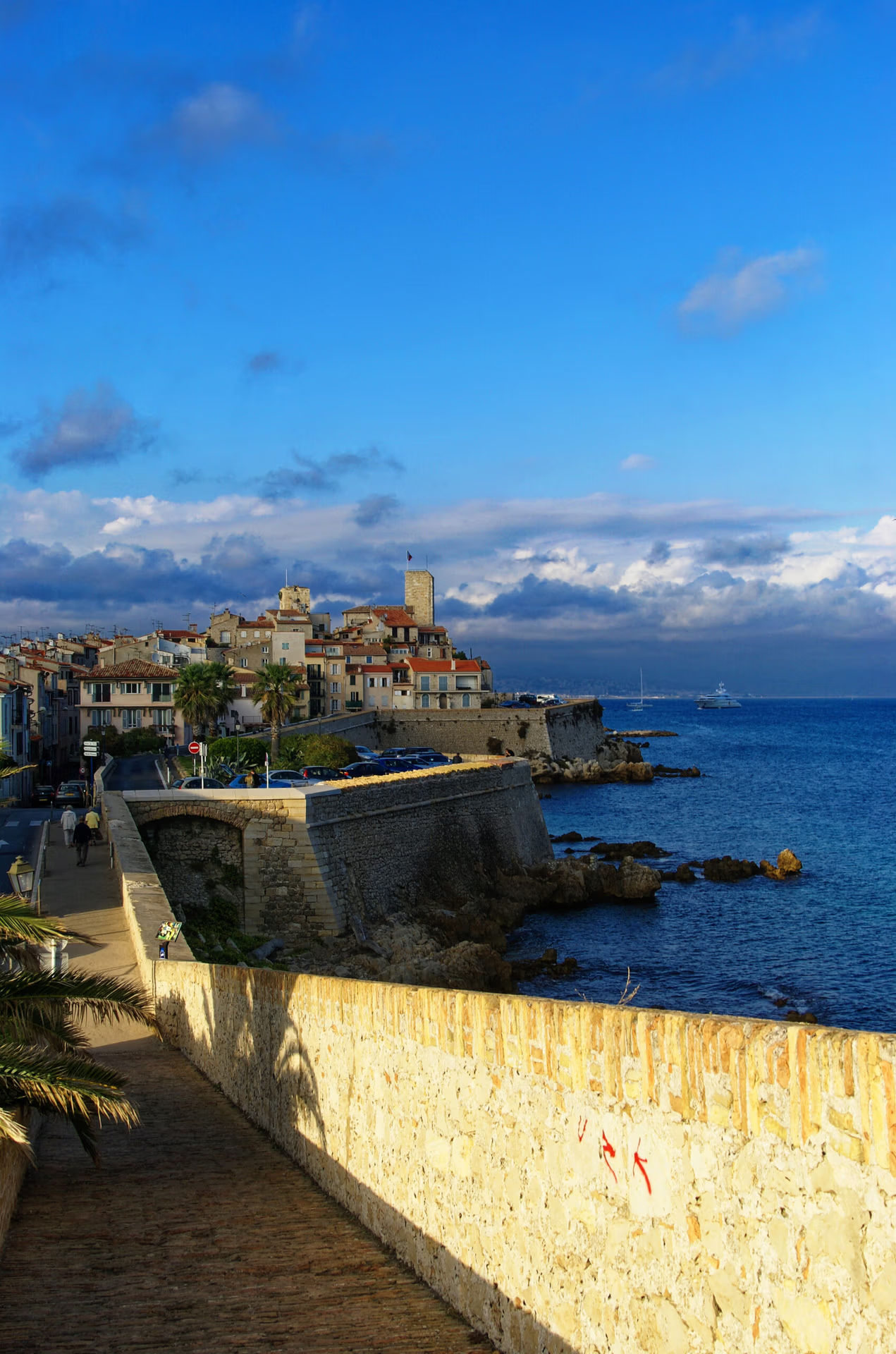
English-taught AI, Data & Cyber Security degrees in France Paris • French Riviera / Sophia-Antipolis • Live Streamed • Online
BSc MSc Executive
Sébastien Corniglion
CEO & Dean, DSTI
Vincent Pressicaud
Vincent Pressicaud
Director of Admissions, DSTI
Jennifer Hyslop
Jennifer Hyslop
Director of Studies, DSTI
Why France

France is a powerful place to study, work and build an international future.

GlobalHome to major multinational groups with careers in France, Europe and worldwide.
EuropeA strategic base for international mobility and professional networks.
BalanceStrong economy, public services, worker protections and quality of life.
TechA serious ecosystem for AI, data, engineering, cybersecurity and digital transformation.
The France message

France is not only attractive. It is professionally relevant.

For students targeting technology careers, France offers a sophisticated economy, a strong industrial base, major global companies and a European environment where international profiles can build credibility.

Digital jobs perspectives

France has a large, qualified and structurally high-demand digital job market.

For AI, Data, Automation, Cyber Security and engineering profiles, the question is not whether digital jobs exist in France. The real question is whether students prepare at the right level for the market.

1.3m people working in digital professions in France, average 2021–2023.
4.6% of all employed workers are in digital professions.
~50% of digital professionals hold a Master's degree or above.
70% of digital workers have managerial responsibilities.
55,600 projected IT professional / managerial recruitments in France in 2025.
Career outlook — APEC 2025

A high-demand sector, even in a difficult economy.

APEC Association for the Employment of Managers: France's reference organisation for executive-level employment trends.

APEC places IT among France's leading professional and managerial recruitment needs. Continental Europe is also largely a Master's-level job market.

  • Scientists and engineers remain strongly sought after.
  • AI, Data, Automation and Cyber Security roles continue to grow structurally.
Why France fits digital careers

A rare mix of academic rigour, engineering culture and strategic industry.

France is not only a study destination. It is a country where scientific tradition, industrial systems and national strategic sectors create serious demand for AI, data and cybersecurity talent.

Academic rigour Deep tradition in mathematics, research and engineering education — highly relevant for AI and computing.
Industrial demand Nuclear, aerospace, defence, finance, telecoms, luxury, mobility and healthcare all depend on robust digital systems.
Technology ecosystem Large corporations, startups, research institutions, international organisations and specialised clusters create a dense digital environment.

Sources: DSTI Facts Sheet, section "02 — Opportunity", using INSEE data on digital professions in France; APEC — Association for the Employment of Managers, "Quels besoins en compétences cadres en 2025 ?", 2025.

Student life in France

France gives students practical advantages that change daily life.

€1Meals in government-funded student restaurants, commonly known as Crous restaurants.
FreeStudent Social Security coverage for healthcare access and reimbursement.
€15–20Typical monthly range for affordable supplementary private health insurance.
€30Typical price of a standard GP consultation before reimbursement.
Everyday savings

Transport and culture are student-friendly.

Students benefit from reduced transport options in Paris and on the French Riviera, plus reduced access to museums, cultural venues and student services.

Family reassurance

France is not only about tuition.

The public student-support environment makes the total study experience more manageable, especially for international families planning carefully.

Why DSTI

A specialist school, not a generic university.

Specialist by design

AI, Data & Cyber

Computer engineering, Data Science, Data Engineering, Artificial Intelligence and Cyber Security are the centre of the school.

International by default

English-medium school

Programmes, teaching, academic support and student-facing life operate in English.

Flexible by design

One connected school

Paris, French Riviera / Sophia-Antipolis, Live Streamed and Online belong to one academic model.

Career-minded

Built for employability

Projects, certifications, paid internships, career support and corporate relations are part of the experience.

DSTI at a glance

Focused scale, international reach and human proximity.

Specialist by design

Large enough to matter. Focused enough to know students.

DSTI is not trying to be a huge generalist institution. It is a sizeable specialist school in AI, Data, Cyber Security and computer engineering, with an international footprint and measurable career outcomes.

One connected school
ParisCentral campus
French RivieraSophia-Antipolis tech park
Online accessLive Streamed & Online asynchronous
2015Created from scratch as a specialist engineering school.
400+Students per year in a focused specialist portfolio.
1,200+Alumni now part of DSTI's graduate community.
7Programmes across Bachelor, MSc, Executive and postgraduate levels.
50+Faculty members and contributors across DSTI's teaching ecosystem.
20+Operational staff members supporting admissions, studies and student life.
70–80%International students in a typical entry.
100+Nationalities received in recent years, from all continents.
95%+Typical employability rate 6 months after graduation.
Campuses and study modes

Two locations in France, plus flexible access when life requires it.

French Riviera CampusTechnology park environment, Mediterranean lifestyle and often the easiest first arrival point into France and Europe.
Paris CampusGlobal city, dense professional ecosystem and strong fit for a major metropolitan experience.
Live Streamed & OnlineJoin live from abroad or study asynchronously when a career cannot be paused.
Life around DSTI

Students choose a programme, their families can also picture daily life.

France becomes a complete study environment: serious academics, two distinctive locations, practical support and student voices that help students and families picture the setting behind the programme choice.

Programmes at a glance

Clear routes from Bachelor to Executive level.

BSc CSE3 years • Computer Science & Engineering
MSc in Data Analytics with Artificial Intelligence2 years • Analytics plus implementation
MSc in Data Engineering for AI2 years • Pipelines, cloud & AI systems
MSc in Data Science & AI2 years • Modelling, ML & deployment
MSc in Cyber Security2 years • Technical cyber route
ENSAM x DSTI1 year • Digital Industry & AI
Duration rule: Bachelor = 3 years • Standard MSc = 2 years • Executive MSc and ENSAM x DSTI Joint PG Programme = 1 year.
Programme fit

Each programme has a clear academic entry profile.

Programme Academic background expected
BSc Computer Science & Engineering DSTI observes grades in science and technology. Previous computing studies are welcomed, but not required.
MSc in Data Analytics with Artificial Intelligence The most open MSc route: essentially accessible to Bachelor holders from a wide range of disciplines.
MSc in Data Engineering for AI Requires prior studies in computer engineering or information systems.
MSc in Data Science & AI Any field where mathematics are used, inc. computer science, industrial engineering, economics etc.
MSc in Cyber Security Requires a background in computer engineering, telecommunications or electronics.
Executive MSc in Artificial Intelligence for Digital Transformation For Master's graduates, or professional equivalent, with around five years of professional experience.
ENSAM x DSTI Joint PG Programme For Master's graduates, including fresh graduates, in any industrial engineering discipline.
Bachelor route

BSc Computer Science & Engineering: science, engineering and professionalism.

UG / BSc route

Scientific foundations

Computing is approached with technical and scientific rigour, not as superficial software training.

Modern engineering stack

Computer architecture, networks, cyber security, data engineering, AI, DevOps and cloud computing.

Enterprise awareness

Students also understand organisations, communication, law, marketing, accounting and sustainability issues.

Best-fit students: strong high-school graduates with scientific potential, curiosity for computing, and willingness to work seriously in English.
Data routes

Two complementary routes: analytics impact and engineering infrastructure.

PG / MSc routes

MSc in Data Analytics with Artificial Intelligence

For students who want to go beyond dashboarding into technical analytics, automation and implementation within real information systems.

  • Statistics, mathematics and programming.
  • Business perspective plus IT depth.
  • Analytics lifecycle from data to operational impact.

MSc in Data Engineering for AI

For students who want to build the data infrastructure that makes AI possible: storage, pipelines, cloud, DevOps and machine learning implementation.

  • Data pipelines and architectures.
  • Cloud, software engineering and CI/CD.
  • Pathway towards AI engineering roles.
Note: eligibility is mainly assessed through transcripts. If there is any doubt about academic readiness, Direction of Studies may require the applicant to take the DSTI Online Entry Exam: 60 questions, split into 30 maths questions and 30 IT questions.
Advanced specialist routes

Data Science & AI, and Cyber Security: two demanding technical paths.

PG / MSc specialist routes

MSc in Data Science & AI

DSTI's flagship master's-level AI pathway, combining mathematical rigour, machine learning, data preparation, validation and IT deployment awareness.

  • Mathematical modelling and validation.
  • Machine learning selection, tuning and enhancement.
  • AI solutions that can be operationalised.

MSc in Cyber Security

A resolutely technical cyber security programme designed around strong computer engineering foundations and operational cyber roles.

  • Systems, networks, low-level software and infrastructure.
  • Cryptography, defence, attack methods and compliance.
  • Human factor, law and project management included.
Note: eligibility is mainly assessed through transcripts. If there is any doubt about academic readiness, Direction of Studies may require the applicant to take the DSTI Online Entry Exam: 60 questions, split into 30 maths questions and 30 IT questions.
Special formats

Two high-value specialist options for professionals and engineers.

Executive route · ENSAM × DSTI route

Executive MSc in Artificial Intelligence for Digital Transformation

A credible alternative to a generic MBA for experienced professionals who need real technical understanding to lead AI-driven transformation.

  • Scientific foundations and AI literacy.
  • Data Science, Data Engineering, Analytics and Cyber Security exposure.
  • Leadership for informed AI decision-making.

ENSAM x DSTI Joint Postgraduate Programme in Digital Industry & AI

A one-year master's-level specialisation combining ENSAM's engineering legacy with DSTI's AI and data expertise.

  • Digital industry, AI and complex systems.
  • Data-driven industrial competitiveness.
  • Strong fit for engineers moving towards Industry 4.0 roles.
Note: eligibility is mainly assessed through transcripts. If there is any doubt about academic readiness, Direction of Studies may require the applicant to take the DSTI Online Entry Exam: 60 questions, split into 30 maths questions and 30 IT questions.
Professional preparation

Academic depth plus recognised certification preparation.

1/yearAt Bachelor level, students prepare for one external professional certification per academic year.
Data & AI routes

Neo4j and route-specific options

MSc routes include preparation for recognised certification exams, with controlled alternatives validated by Faculty and Direction of Studies.

Cyber Security

Security stack visibility

The Cyber route connects technical teaching with certification preparation across systems, cloud, networks and cyber operations.

Executive MSc

Digital transformation tools

Professional learners connect AI, data, cloud and enterprise-platform skills with certifications such as Neo4j, AWS and Microsoft PL-200 where relevant.

Preparation, not automatic awarding.

DSTI embeds professional certification preparation to make technical skills more visible to employers. External certification bodies keep their own exam rules, and alternatives remain controlled by DSTI's academic teams.

Academic quality and care

Strong faculty, formal assessment and a human Direction of Studies.

Academic standards

DSTI combines demanding expectations with close academic follow-up.

The published academic framework makes progression rules explicit, including a 60% pass threshold. Students are supported, but the academic bar remains serious.

Direction of Studies

Care is operational, not decorative.

DSTI's Direction of Studies follows academic progression, teaching quality, attendance, student situations and practical continuity across On campus, Live Streamed and Online asynchronous study.


50+Faculty members and contributors across DSTI's teaching ecosystem.
60%Published pass threshold: students must reach a demanding level of mastery.
Academic + professionalResearchers, academics, practitioners and internal experts contribute to delivery.
Transparent rulesSupport, progression and assessment are framed by public academic procedures.
Employability

Students do not just study. They become market-ready.

97%Find an internship within 6 months after the end of studies.
95%Find a job within 6 months after graduation.
600+Companies have employed DSTI students and graduates.
30 ECTSThe final internship is mandatory, evaluated and part of the degree.
Internships in France

Mandatory, paid and academically recognised.

Longer internships are paid by law. DSTI students typically receive around €800 / month at Bachelor level and €1,200 / month at Master's level.

Why results are strong

Preparation starts from day one.

Technical projects, certification preparation, CV and public profile support, job-board guidance, alumni examples and active follow-up from academic and corporate relations teams, including for experienced Executive MSc learners.

Real outcomes

Real graduates. Real employers. Not random logos.

These public LinkedIn examples make career pathways concrete, including early-career and experienced Executive profiles.


Air Liquide
Airbus
Airbus Defence and Space
Allianz
Amadeus
Amazon
Atos
Balenciaga
Bayer
BBVA
BNP Paribas
Carrefour
EDF
Fortinet
L'Oréal
Meta
Michelin
Samsung
Sanofi
Schneider Electric
Société Générale
Stellantis
TotalEnergies
Worldline

Concrete examples, not promises.

These public examples show that the pathway is real, while outcomes remain linked to technical maturity, communication, experience, timing and each student's own work.

Executive and professional outcomes

Not every DSTI learner is starting from zero.

Executive and experienced learners often use DSTI for career repositioning, AI transformation responsibility, entrepreneurial credibility or stronger technical leadership.

Tuition fees

Clear pricing in euros.

Programme / study modeTuition in EUR
BSc / MSc Data programmes — On-campus, per year€14,000
MSc in Cyber Security — On-campus, per year€18,000
Executive MSc in Artificial Intelligence for Digital Transformation — full programme€15,500
ENSAM x DSTI Joint PG — full programme€12,500
Live Streamed BSc / MSc Data — per year€5,000
(€6,500 for MSc Cyber)
Online asynchronous — total€7,200

Tuition information is presented in euros. Applicants should always refer to the official DSTI tuition-fee and scholarships pages and admissions overview for the applicable intake and study mode.

Merit-based scholarships

A scholarship scale designed to attract strong applicants.

DSTI scholarships are selective, merit-based and assessed with the admissions file. They are not automatic, but they are not restricted by nationality.

A+ 50%

Highest academic profiles

Reference saving: €7,000 on €14,000
A 30%

Excellent academic profiles

Reference saving: €4,200 on €14,000
B+ 20%

Strong academic profiles

Reference saving: €2,800 on €14,000
B 10%

Good academic profiles

Reference saving: €1,400 on €14,000
How it works

No separate scholarship application.

When a profile justifies it, the Admissions Jury grants the scholarship together with admission. Merit is interpreted fairly across grading systems and local academic contexts.

Eligibility logic

Selective, not automatic.

Scholarships support high-merit applicants and are designed to help DSTI attract the strongest students. Applicants should always refer to the official tuition fees and scholarships page for current terms.

Payment and refund policy

Clear payment terms, public rules, and fair visa-refusal protection.

25%

Upon admission, net of scholarship.
50% may apply for some South Asian countries due to visa requirements.

25%

Before the start of classes.
N/A for South Asian countries.

50%

Before the start of the second term.

Visa refusal

If the student visa is refused, tuition deposits are refunded minus a €250 administrative fee.

Why a 250€ retainer?

The €250 retained fee is not a penalty. It reflects the real processing, administration, document preparation and FeelFrançais visa-preparation support already provided during the admissions process.

DSTI applies a clear and public tuition fees refund policy: dsti.school/tuition-fees-refund-policy.
Accommodation and living costs

Housing support and clear budgets make France less intimidating.

Student residences

Student residence options can be reassuring for international families and may avoid the need for a French guarantor.

Verified rentals

Studapart helps students find apartments or shared rooms, with a guarantor option for students without a local guarantor.

Monthly guidance
€1,000Approximate monthly budget on the French Riviera
€1,200Approximate monthly budget in Paris
Accommodation support is a practical part of the pathway: you need to know where students can live, how housing can be secured, and what monthly life realistically costs.
Admissions

A selective but clear process, with a live interview for every applicant.

1

Application

Academic fit, motivation and programme match are reviewed.

2

English evidence

IELTS 6.0 / B2 or equivalent major test, including Duolingo, unless previous studies were officially in English.

3

ID verification

A quick Stripe ID check is completed before interview booking.

4

Live interview

Applicants book their English-language admission interview through DSTI's meeting system.

Admissions and scholarships remain DSTI decisions.

Applicants can ask questions and receive support at every stage, but admissions decisions and scholarship allocations are handled solely by DSTI's internal teams.

Student visa support

Visa preparation is serious, structured and supported.

FeelFrançais support included

DSTI includes FeelFrançais support at no extra cost for admitted students.

Students receive support for process understanding, document preparation and interview readiness where relevant. Visa decisions remain sovereign decisions, but preparation matters enormously.

90%+DSTI's global student visa success rate has been around, and often above, 90% since 2015.
During studies

Student work rights

French student visas allow paid student work up to 964 hours per year, giving more flexibility than a fixed weekly limit.

Use the Admissions and Fees & Scholarships pages for live details.
Some local requirements vary by country. DSTI and FeelFrançais help students prepare carefully while avoiding false guarantees.
Working in France

The French job market offers comfort, protection and long-term stability.

5 weeks+Paid holidays are a real part of working life, not a theoretical benefit.A visible difference for families: France treats rest, holidays and work-life balance as part of normal professional life.
ProtectedEmployment rules create a more structured and predictable work environment.For international graduates, structure can make a first professional experience abroad feel more predictable.
BenefitsCommon support includes meal vouchers, health coverage and workplace advantages.
Safety netFrance provides systems for professional training, unemployment support and family-related benefits.
Why this matters

A career is also a quality-of-life decision.

For prospective students and families comparing international options, France can offer not only an entry into high-value digital careers, but also a more protective and balanced professional environment.

Learn French while in France

French is a global business language with growing international reach.

A language of opportunity

French is not only the language of France.

France Diplomatie, based on the 2026 OIF report, presents French as one of the world's most widely spoken languages, with 396 million speakers across five continents and 170 million learners of and in French.

For internationally mobile graduates, French adds access to professional networks in Europe, international organisations, public institutions, culture, luxury, engineering, energy, mobility and services.

English + French A strong professional combination for students who want European mobility, international credibility and better integration into the French job market.
Broader global reach than GermanGerman is very valuable in parts of Europe. French offers wider global distribution and a rising speaker base, which makes it especially relevant for international careers.
Useful from day one in FranceStudents can study in English while progressively building practical French for daily life, internships, networking and employment.
Integrated in the BachelorDSTI's Bachelor programme includes French classes, helping students make practical progress while studying technical subjects in English.

Source note: France Diplomatie summarises the OIF 2026 report with 396 million French speakers worldwide and 170 million learners of and in French.

Post-study pathway

Study in France, then move into the job market with a clear legal route.

1 After graduation

12-month job-seeking permit

Graduates can normally apply for a post-study residence permit to look for work or launch a professional project in France.

2 French advantage

Studies + internship exposure

Graduation usually comes after a substantial internship period, so students have already been exposed to the job market.

3 Then what?

Employment-based residency

Staying in France is based on securing a suitable job and meeting legal conditions, not arbitrary quotas.

4

France can be a place to launch a career.

The pathway is credible because it combines degree studies, paid internship, employability support and legal post-study options for graduates who secure employment.

The objective is not only to study abroad, but to make the transition from study to professional life understandable and credible.
Questions and next steps

Let's help you choose the right DSTI pathway.

Questions applicants usually ask

What should I clarify before applying?

  • Which programme fits my academic background?
  • Which study mode fits my situation?
  • What documents should I prepare?
  • Can I be considered for a scholarship?
  • How should I plan accommodation, visa and arrival in France?
Continue the conversation

DSTI Admissions can guide you through the next step.

Prospective students and applicants can discuss programme fit, documents, scholarship potential, application timing and practical preparation with DSTI Admissions.